


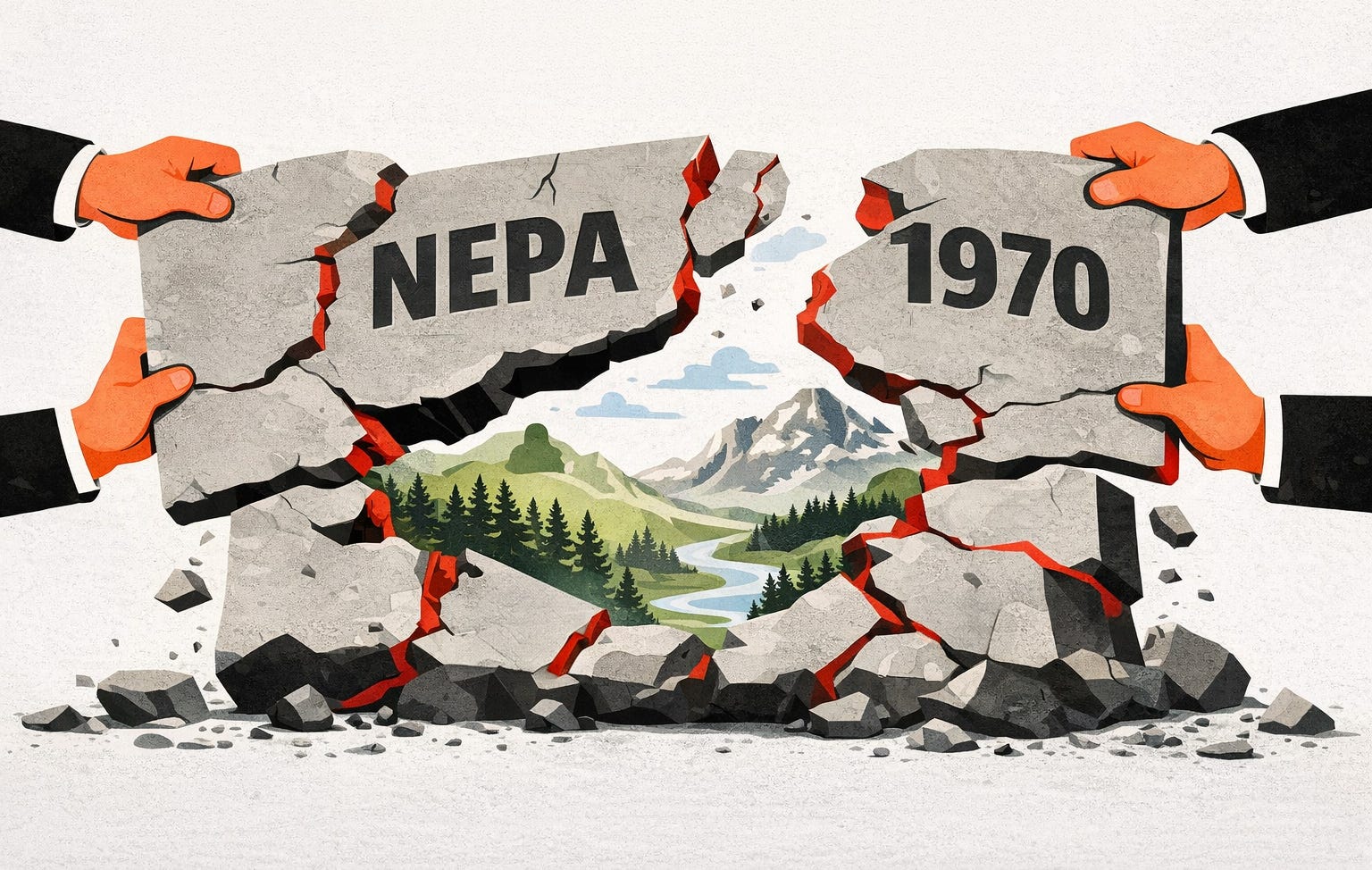
Read the news often enough or look at press releases from Congressmen and this administration and you’ll see a common refrain. People from across the political spectrum telling you NEPA is broken. That it’s a dinosaur. That it’s strangling American energy, killing jobs, and standing in the way of the gleaming infrastructure future we all deserve.
They’re lying.
What’s actually happening is one of the most brazen, coordinated corporate power grabs in modern American history — a four-pronged assault on the single most important environmental law in the United States, executed simultaneously through the executive branch, the courts, Congress, and the media. And they’re counting on you not to notice.
Let’s be clear about what’s at stake. The National Environmental Policy Act isn’t some radical invention of the green left. It was signed into law by Richard Nixon after passing the House and Senate with overwhelming bipartisan support.
The House passed it 372–15.
The Senate passed it 91–0.
Ninety-one to zero.
For more than fifty years, every president, Republican and Democrat, operated under its framework with tweaks along the way. It was widely respected across the political spectrum because it did something profoundly simple and profoundly American: it forced the government to look before it leaped.
Before a company could bulldoze a wetland, clear-cut a forest, or dump toxic waste into a community’s water supply, NEPA guaranteed the public a right to know what was coming — and the government had to at least consider whether there was a smarter, safer way.
That’s it. That’s the law they’re trying to destroy.
The Four-Front War on NEPA
To understand just how dangerous this moment is, you need to see the full picture. This isn't one rogue executive order or one bad bill. It's a coordinated assault — four simultaneous fronts hitting NEPA from every direction at once. Each front reinforces the others. Each one would be alarming on its own. Together, they constitute the most sophisticated campaign to dismantle an American environmental law in this country's history.
1. Executive Destruction
On his first day back in office in January 2025, Trump signed Executive Order 14154, “Unleashing American Energy,” which directed the Council on Environmental Quality to gut its own NEPA regulations. By February 25, 2025, CEQ had done exactly that — torching every single regulation that had governed environmental reviews for nearly half a century. The 1978 regulations crafted under Jimmy Carter by Gus Speth, one of the most visionary environmental lawyers of the twentieth century, were erased from the Code of Federal Regulations in a single stroke. No replacements. No transition plan. Just a wipeout.
Then, on July 3, 2025, in a coordinated blitz, nearly every major federal agency — Interior, Energy, Agriculture, Transportation, Defense, the Army Corps of Engineers, and more — simultaneously published their own “reformed” NEPA procedures, most of which gutted public participation requirements, narrowed the scope of environmental reviews, and shifted binding regulations into nonbinding “guidance” that can be changed on a whim.
And two days ago the Department of the Interior dropped the final shoe, announcing what it calls “final sweeping reforms” that rescind more than 80 percent of Interior’s prior NEPA regulations. The woman proudly announcing this destruction? Karen Budd-Falen, a lifelong Sagebrush Rebel, Cliven Bundy’s former attorney, a rancher with millions in western landholdings and Exxon Mobil stock — and now the third-highest-ranking official at the agency responsible for managing America’s public lands. You can’t make this stuff up.
On January 8, CEQ Chair Katherine Scarlett declared that “NEPA’s regulatory reign of terror has ended.” Reign of terror. That’s what they’re calling the law that kept uranium tailings out of the Colorado River and made sure military aircraft didn’t destroy Joshua Tree. A reign of terror.
2. The Courts
The Supreme Court has spent the last three years systematically dismantling the legal architecture that made environmental law enforceable.
In 2022, West Virginia v. EPA invented the “major questions doctrine” — a rule that says agencies need explicit congressional authorization before taking any action a court deems nationally significant. It was designed to kneecap the EPA’s ability to regulate carbon emissions, and it worked. But the doctrine’s reach extends far beyond climate policy. It gave judges a new tool to strike down any ambitious agency action by simply declaring the question “major” — a standard so vague that it functions as a blank check for judicial override.
In 2024, Loper Bright Enterprises v. Raimondo finished the job by overturning Chevron deference — the forty-year-old principle that courts should defer to agency expertise when interpreting ambiguous statutes. Chevron was the reason scientists, not judges, got to decide how to implement the Clean Air Act. It was the reason the Forest Service could use its expertise to manage roadless areas. It was the reason the EPA could determine what counts as a pollutant under the Clean Water Act. Now every agency interpretation is subject to a judge’s “independent judgment” — meaning any federal court in the country can substitute its reading of an environmental statute for the expertise of the scientists and professionals who actually understand the science.
Then in May 2025, Seven County Infrastructure Coalition v. Eagle County applied this new framework directly to NEPA. The ruling told agencies they could narrow the scope of their environmental reviews to only the most immediate, proximate impacts of a project — no need to consider what happens upstream or downstream. An 88-mile oil railway in Utah’s Uinta Basin? The agency doesn’t have to consider the drilling it enables or the refining it feeds. The D.C. Circuit had already questioned CEQ’s authority to issue binding regulations in Marin Audubon Society v. FAA in late 2024, giving the administration the legal cover it needed to claim CEQ never had the power to set uniform standards in the first place — a claim that is historically absurd, but jurisprudentially convenient.
Three decisions. Three years. The courts stripped agencies of their interpretive authority, gave judges the power to override scientific expertise, and told the executive branch it could shrink environmental reviews down to almost nothing — and then this administration did exactly that.
3. Congress
In July 2025, Trump signed the "One Big Beautiful Bill Act," which included a new pay-to-play provision allowing corporations to fork over 125 percent of review costs to fast-track their environmental assessments. An EA in 180 days. A full EIS in one year. For projects that reshape ecosystems and determine whether your children will drink clean water. The original version of the bill would have let corporations pay to bypass judicial review entirely — they only dropped that provision because the Senate Parliamentarian ruled it out of bounds for reconciliation. Let that sink in: they tried to let companies buy their way out of court oversight, and the only thing that stopped them was a procedural technicality.
Then in December, the House passed the SPEED Act, sponsored by Republican Bruce Westerman and Democrat Jared Golden of Maine, by a vote of 221 to 196. This bill is being sold as sensible, bipartisan reform. It’s nothing of the sort. It’s a dagger aimed at the heart of NEPA. That bill is now in committee in the Senate.
4. The Media
If you’ve been reading the editorial pages of America’s biggest newspapers over the past year or more, you’ve been unknowingly marinating in NEPA reform propaganda.
And they've been smart about it. They haven't just run the attack from one ideological direction. They've covered the entire spectrum — right, center, and left — so that no matter who you are or what you read, you encounter the same conclusion dressed up in your preferred language.
The WSJ editorial board declared that NEPA is “the killer whale of federal regulation” and insisted “Congress has no greater priority than permitting and NEPA reform.” The Washington Post editorial board published a piece just days before the House SPEED Act vote arguing that NEPA has become “a blockade that prevents common-sense projects from moving forward.” The New York Times editorial board published a lengthy piece in 2023 arguing that NEPA's requirements "have become unnecessarily cumbersome" and are blocking the renewable energy buildout the country desperately needs.
And Bloomberg ran an opinion piece by Stuart Levenbach back in 2021 warning the Biden administration not to undo Trump's first-term NEPA "reforms" and arguing that federal permitting was itself a "crisis" standing in the way of clean energy and infrastructure. Bloomberg failed to mention that Levenbach was a Trump appointee who had since been working as the Public Affairs Director for Baker Hughes, one of the largest oil field services companies in the world. Whoops.
These aren’t independent editorial judgments arrived at through rigorous analysis. They’re the talking points of the American Petroleum Institute dressed up in respectable fonts.
The House Natural Resources Committee gleefully quote-tweeted the WSJ editorial the same day it was published to drum up support for the SPEED Act. The National Electrical Manufacturers Association amplified it. Industry trade groups across the fossil fuel and industrial sectors echoed the same language, the same framing, the same urgency — all within the same news cycle.
This is how manufactured consent works. You flood the information ecosystem with a single narrative — NEPA is broken, NEPA kills jobs, NEPA blocks progress — until it becomes conventional wisdom. Until even people who should know better start nodding along. Until moderate Democrats feel safe voting for legislation written by the oil lobby because the New York Times editorial board gave them cover. The think tanks produce the white papers. The editorial boards launder them into mainstream respectability. The politicians cite the editorials. And the industries funding all of it pop champagne.
The American Enterprise Institute has scholars openly calling for NEPA’s full repeal. The Heritage Foundation’s Project 2025 laid out the entire playbook for dismantling environmental protections — and the current administration is executing it chapter and verse. The Bipartisan Policy Center convenes roundtables conveniently framed around the SPEED Act’s provisions, with participants who “broadly agreed” the system needs reform — a conclusion baked into the invitation list. This isn’t a national debate. It’s a corporate information operation with a nine-figure budget and a half-century grudge against the idea that the public should have a say before its land gets strip-mined.
And it’s working. The narrative has become so pervasive that questioning it makes you sound unreasonable. That’s the whole point.
The SPEED Act: A Corporate Wish List Disguised as Reform
Let’s talk about what the SPEED Act, which already passed the House, actually does, because the marketing language is designed to make you think this is about building bridges faster.
The bill restricts agencies to evaluating only those impacts “proximately caused” by the immediate project — effectively barring consideration of climate change effects, which by definition occur in locations distant from the source of emissions. If a company wants to build a massive new pipeline, the reviewing agency would be prohibited from considering the downstream carbon pollution that pipeline enables. That’s not reform. That’s willful blindness codified into law.
It bars the use of any scientific research published after a project is proposed. Read that again. If a new wildfire risk map comes out, or an updated climate model reveals a project sits in an increasingly vulnerable floodplain, or new health data shows a toxin is more dangerous than previously understood — too bad. The science doesn’t count if it’s inconvenient to the project timeline. In what universe does ignoring the most current science make environmental reviews better?
It slashes the statute of limitations for legal challenges from six years to 150 days. For a community that discovers a flawed review months after the fact — say, when they start getting sick, or when their well water turns brown — the courthouse door will already be locked.
And here’s the provision that should make your blood boil: the SPEED Act eliminates the standard judicial remedy of vacating unlawful agency actions. Under current law, if a court finds that an agency violated NEPA, the court can halt the project until the violation is corrected. Under the SPEED Act, the project keeps going while the agency “fixes” the problem. Bulldoze first, consider impacts later.
And this has more than 300 endorsers — overwhelmingly from the oil and gas industry, the mining industry, and construction industry groups. The American Petroleum Institute’s CEO praised it. The Texas Independent Producers and Royalty Owners Association called permitting reform “mission critical.” The American Oil and Gas Reporter celebrated its passage.
When the oil industry is popping champagne, you should be asking who’s paying for the party.
More than 150 environmental and community organizations sent a letter to Congress opposing the bill. Stanford law professors warned it would render NEPA meaningless. The Sierra Club, NRDC, Earthjustice, the Climate Justice Alliance, Public Citizen, and the League of Conservation Voters all stood in opposition. But none of that mattered, because the narrative had already been set — by the editorial boards, by the think tanks, by the four-front war machine.
And that narrative found its most useful soldier in Jared Golden, the Maine Democrat who co-sponsored this corporate wish list and called NEPA “onerous, overly complex and ripe for litigation abuse.” He used the same language as the American Petroleum Institute. Word for word. When your talking points are indistinguishable from the oil lobby’s, you aren’t being bipartisan — you’re being used.
The Big Lie: NEPA Is the Problem
The entire campaign to “reform” NEPA rests on a manufactured narrative so persistent and so well-funded that even people who should know better have started repeating it. The story goes like this: NEPA reviews take forever. They cost too much. They’re weaponized by radical environmentalists to block good projects. America can’t build anything anymore, and NEPA is the reason why.
It’s a compelling story. It’s also largely false.
Let’s start with the numbers the “reformers” don’t want you to see. According to a 2014 Government Accountability Office report, less than one percent of federal projects require the most time-consuming level of NEPA review — a full Environmental Impact Statement. Of those, only two-tenths of one percent have lawsuits filed against them. The "litigation quagmire" the SPEED Act claims to solve is a fiction.
Ninety-five percent of federal projects sail through on categorical exclusions and never trigger a detailed review in the first place. Oh, and when lawsuits are filed, the challengers lose 80 percent of the time.
The median Environmental Impact Statement takes between two and four years — for projects that will reshape landscapes for generations.
These aren't my numbers. They're directly from government agencies. And there’s plenty more evidence.
Here's the part that’s really maddening: the foundational study that launched the modern anti-NEPA campaign was a fraud. A 2015 report by a group called Common Good — titled "Two Years Not Ten" — claimed that shortening environmental reviews would save the country $427.8 billion. The Trump administration cited it. The think tanks amplified it. It became gospel.
The problem? The report's assumptions were fabricated. It assumed every project required a full EIS. It used a cost inflation rate of 5.1 percent when actual federal data showed half of one percent. It assumed all highway congestion would vanish if you shortened reviews — ignoring decades of transportation research showing that expanded highway capacity induces demand and congestion returns to equilibrium. It assumed freight rail delays were caused by NEPA despite the fact that freight railroads are privately financed and most of their projects don't even trigger federal review. The entire intellectual foundation of NEPA "reform" is built on junk math and industry talking points dressed up as research.
And the delays that do exist? Study after study — from the GAO, from peer-reviewed journals, from the Center for Progressive Reform's review of more than forty separate analyses — consistently finds the same thing. The primary drivers of project delay are not NEPA reviews. They're insufficient agency funding, chronic understaffing, poor interagency coordination, and compliance requirements under other laws.
The solution is simple: Fund the agencies. Staff the offices. Improve coordination. Those are the solutions that actually work.
But those solutions don’t serve the interests of the people funding this campaign, because those people don’t want faster reviews. They want no reviews.
This is the same playbook that's been used to dismantle every piece of the New Deal and Great Society that built the American middle class. Defund the agencies. Starve the workforce. Let the system degrade. Then point to the degraded system and say: see, government doesn't work. It's been the strategy for decades — from public schools to the postal service to the EPA to NEPA. Create the problem, then sell the "solution" that happens to make the people who created the problem enormously wealthy.
The People Writing the New Rules
Here’s another part that should keep you up at night.
When the Trump administration gutted CEQ’s NEPA regulations and told every federal agency to write its own replacement rules, they handed environmental review policy to the very industries it was designed to regulate. This administration is stacked top to bottom with industry insiders.
At Interior, you have Secretary Doug Burgum, the former North Dakota governor who built his political career on fossil fuel friendliness, and Karen Budd-Falen, who spent her entire legal career fighting environmental protections on behalf of ranchers and extractive industries — and who holds Exxon Mobil stock while overseeing environmental policy for America’s public lands. The head of the U.S. Forest Service is a former logging industry executive. The Department of Energy is run by Chris Wright, a fracking executive who calls fossil fuels “a humanitarian necessity.”
These are the people now writing the rules for what counts as an adequate environmental review. Oil and gas lobbyists. Timber lobbyists. Mining lobbyists. The same industries that have spent decades fighting NEPA in court are now drafting its replacement framework.
The new agency procedures have shifted from binding regulations — developed through public notice and comment — to nonbinding “guidance” documents that can be altered without public input. Interior moved most of its NEPA procedures into a “handbook” that exists outside the Code of Federal Regulations entirely. This means the rules can be weakened further, at any time, without any public process whatsoever.
The Madness of “Reform” Under This Administration
Even if you believe NEPA needs reform — and I’ll grant that reasonable people can disagree about process improvements — you would have to be out of your mind to pursue NEPA reform right now. Under this administration. With these people in charge.
Think about it. Weakening the single most important check on government-approved environmental destruction at the exact moment when the government is run by the industries that want to do the destroying. Making it easier to fast-track pipelines when the Secretary of Energy is a fracking CEO. Narrowing the scope of environmental reviews when the Interior Department is run by a Sagebrush Rebel and oil and gas lobbyists. Shortening the timeline for public comment when the entire executive branch has been staffed with people whose careers were built on silencing public comment.
It’s like handing the car keys to someone who just told you they plan to drive into a wall, and then removing the airbags because they’re “burdensome safety features that slow down the driving experience.”
Jared Golden and every other Democrat who voted for the SPEED Act should be ashamed. Not because permitting reform is an illegitimate conversation — but because having that conversation right now, with these people, in this political environment, based on false data and industry talking points, is either breathtakingly naive or deeply cynical. When the American Petroleum Institute and the Texas oil lobby are celebrating your legislation, you don’t get to pretend you’re fighting for working families.
What We Actually Need
We don’t need NEPA reform. We need NEPA defense.
We need Congress to codify the 1978 Carter-era CEQ regulations — the ones crafted by Charles Warren and Gus Speth, the ones that served this country faithfully for nearly fifty years. Those regulations should be written into statute so that no future president can erase them with an executive order over a weekend.
We need to fund the agencies that conduct NEPA reviews. If reviews take too long, the answer isn’t to eliminate the reviews — it’s to give agencies the staff, the resources, and the training to do them well and do them efficiently. The Biden administration actually demonstrated this on a small scale: CEQ reported in January 2025 that NEPA timelines were significantly shorter than just a few years earlier, because agencies were better staffed and better coordinated.
We need to restore public participation requirements that this administration has gutted. The Builder Act amendments of 2023 require public notice when an agency intends to prepare an EIS — but they don’t explicitly require public review of and comment on draft NEPA documents. The new agency procedures are exploiting this gap to cut the public out of the process. That must be closed by statute.
We need to protect judicial review. The SPEED Act’s 150-day filing deadline and its elimination of vacatur as a remedy would make NEPA litigation functionally impossible. Courts are the last line of defense when agencies cut corners or ignore the law. Weakening judicial review doesn’t speed up good projects — it removes accountability for bad ones.
And we need to wake up to what’s actually happening. This isn’t about building bridges faster. This isn’t about common-sense reform. This is about money. This is about the fossil fuel industry, the mining industry, the timber industry, and the tech industry systematically dismantling the legal framework that has protected American land, water, air, and communities for more than half a century — with the full cooperation of a government they have purchased outright.
The Stakes
NEPA doesn’t block progress. It demands that progress be responsible. It forces agencies to ask: Is there a safer way? A smarter way? A way that doesn’t leave the next generation holding the bag?
For over fifty years, that question — simple, reasonable, profoundly democratic — has been the foundation of American environmental law. It was the model exported to more than 100 countries around the world. Not because those nations were forced to adopt it, but because it worked. It proved that economic development doesn’t have to mean environmental destruction.
And now the very country that pioneered this idea is tearing it apart. The country that once set the global standard for environmental protection is being run by the very industries that standard was designed to restrain.
Environmental reviews aren’t supposed to be quick or easy. When you’re talking about projects that could reshape entire ecosystems, pollute waterways, exterminate animals, or unleash toxic waste into communities, the process should be thorough. That doesn’t make NEPA some left-wing straitjacket — it’s basic common sense, proudly signed into law by a Republican president.
If protecting the air we breathe and the water we drink slows things down a little, so be it. NEPA has saved far more than it’s ever delayed, and anyone telling you otherwise is selling something — usually oil, gas, timber, or data centers.
The campaign to “reform” NEPA is a campaign to destroy it. And the people leading the charge aren’t trying to build a better America. They’re trying to strip-mine the one we have left.
How To Fight Back
If you want to fight back, here’s what you can do:
Contact your senators and tell them to oppose the SPEED Act, which now awaits action in the Senate Environment and Public Works Committee. Demand that Congress codify the 1978 CEQ NEPA regulations, which represent the barebones minimum framework.
Support the environmental organizations — Earthjustice, NRDC, Sierra Club, the Center for Western Priorities, and others — that are fighting these rollbacks in court. And share this article with anyone who needs to hear the truth.
Capitol Switchboard: 202-224-3121
Sample Letter to Your Senator
Copy, paste, personalize, and send. Find your senators’ contact information at senate.gov or drop a comment below and I’ll send you their contact info.
Subject: Oppose the SPEED Act — Protect the Public’s Right to Know
Dear Senator [Name],
I’m writing to urge you to oppose the SPEED Act.
This bill is being sold as common-sense reform. It is not. It would bar federal agencies from considering the most current science when reviewing major projects. It would slash the window for legal challenges from six years to 150 days — meaning communities that discover contaminated water or flawed reviews after the fact would have no recourse. And it would eliminate the courts’ ability to halt projects that violate the law. Under the SPEED Act, a company will be able bulldoze first and answer questions later.
NEPA was signed into law by Richard Nixon. It has been upheld and respected by every president of both parties for over fifty years. It doesn’t block projects — it ensures the public gets a voice before its land, water, and air are put at risk. That’s not a partisan principle. That’s an American one.
The SPEED Act has more than 300 industry endorsements, led by the American Petroleum Institute. More than 150 environmental and community organizations oppose it. When the oil lobby is celebrating and every major conservation group in the country is sounding the alarm, that should tell you everything you need to know about who this bill serves.
Please do not misunderstand me. Review and permitting reform is not inherently bad. But overwhelming evidence from years of studies and government data shows that delays come from understaffing and underfunding the agencies that conduct the reviews, not from NEPA itself.
Please do not take part in the continued erosion of protections that previous generations of Americans fought for and won. NEPA, like so many of the laws now under attack, exists because ordinary people demanded a voice before powerful interests could reshape their communities. Dismantling these protections doesn't serve your constituents. It serves the billionaire class that is systematically replacing a system built for the public good with one rigged in its own favor.
I sincerely hope you will see this bill for what it is and put a stop to it. I will be watching closely.
Respectfully,
[Your Name]
Thanks for reading. Until next time,
Jim
Also remember that Jared Golden was one of only two Democrats in the House who voted in favor of H.J. Res. 140, which would pave the way for mining near the Boundary Waters.
He’s making a name for himself quickly here, and it’s not a good one.
I ran a boutique printing company for 40 years. This is exactly the process I have watched over many years to destroy the US Postal Service, which IMHO is essential to our national security. Defund, cut labor and service, raise prices, until the public agrees it is a dysfunctional organization, then privatize it to "fix" it.