


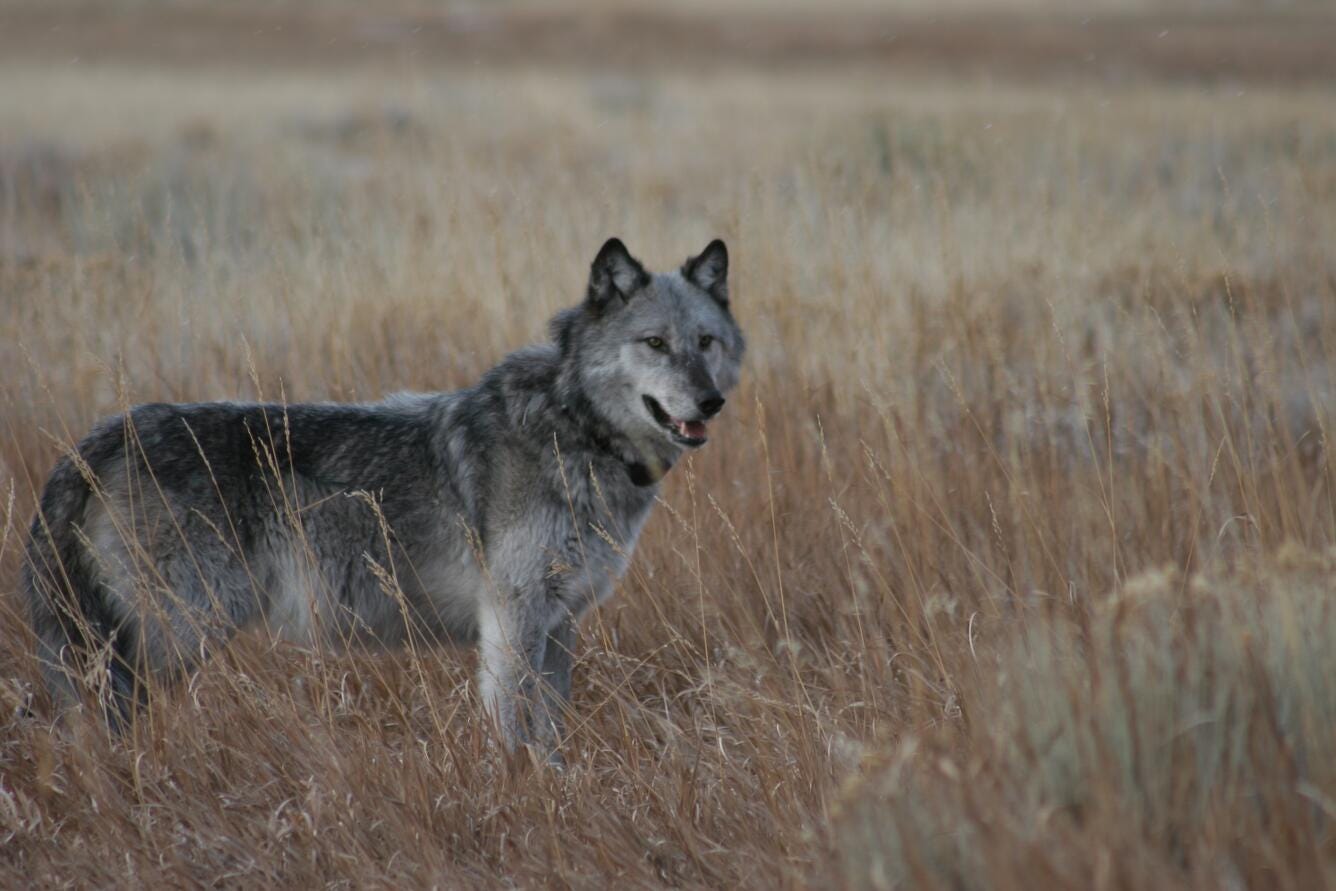
On Monday, the U.S. Fish and Wildlife Service published a notice in the Federal Register that reads, on its face, like a routine bureaucratic request. They’re asking the public for “information” about how Colorado is implementing its gray wolf reintroduction program. How’s the livestock conflict going? Is the compensation fund working? Are agencies coordinating?
Sounds reasonable, right? It’s not. It’s a trap.
This Request for Information is the latest move in a months-long federal campaign to sabotage, seize control of, and ultimately destroy a wolf recovery program that Colorado’s own citizens voted for. And the weapon they’re using to do it is the very law that was written to save these animals from extinction: the Endangered Species Act.
Let that sink in. The federal government is using the Endangered Species Act — the most important wildlife protection law in American history — not to protect gray wolves, but to prevent their recovery. To override the democratic will of an entire state. To hand a win to the ranching industry. And to put a man who spent his career decimating wolves in charge of deciding their fate.
What They Want to Destroy
In 2020, Colorado’s citizens went to the ballot box and passed Proposition 114, directing their state government to reintroduce gray wolves to western Colorado. It was the first time in American history that voters used the ballot to mandate wildlife restoration. It wasn’t a legislative backroom deal. It wasn’t an executive order. It was democracy, pure and simple. The people spoke.
And the program was working. Colorado Parks and Wildlife released its first wolves in December 2023 and a second group in January 2025. Pups were born in the wild in spring 2024 — the first wolf pups born in Colorado in nearly 80 years. The species was gaining a foothold in a state where it had been exterminated generations ago. This is exactly what wolf recovery is supposed to look like: a state stepping up to help bring an endangered species back from the brink, one careful release at a time, contributing to the broader recovery of a species that was nearly wiped off the face of the continent.
Gray wolves are endangered. The whole point of the Endangered Species Act is to recover them. Colorado’s program is doing exactly that. And the federal government, the entity charged with ensuring the species’ survival, is now trying to shut it down.
The Man Behind this Morbid Campaign
The architect of this assault is Brian Nesvik, the Trump-appointed director of the U.S. Fish and Wildlife Service. Before that, Nesvik ran the Wyoming Game and Fish Department, where he oversaw one of the most hostile wolf management regimes in the country. Under his watch, Wyoming maintained a “predator zone” covering roughly 85% of the state where wolves could be shot on sight, year-round, with no tags, no bag limits, and no questions asked.
That policy produced the Daniel, Wyoming incident in February 2024 — where a man ran down a young female wolf with a snowmobile until she was so broken he could tape her mouth shut. He then brought her to the Green River Bar in Daniel, where he paraded her around, posed for photos, and even kissed her muzzle while she lay barely conscious on the floor. Then he dragged her behind the building and killed her.
The penalty from Nesvik’s agency? A $250 fine. For illegal possession of a live wolf. Not for the cruelty. Not for the torture. For possession.
But here’s what Nesvik’s agency didn’t tell the public: the warden who cited Roberts had the authority to issue a “must-appear” citation that would have forced him before a judge, where he could have faced up to $1,000 in fines and six months in jail. The warden chose not to. And then Nesvik’s agency actively covered that up. An April 2024 press release stated that fines were “set in state statute.” The Game and Fish Commission declared it was “satisfied that every tool we have available was used, and used to the best of our ability.” That was false. And they knew it was false.
It wasn’t until months later, at a June 2024 working group meeting, that Nesvik himself admitted wardens had the discretion to pursue steeper penalties all along. That was the first public admission that the agency could have done more — after weeks of telling the world their hands were tied.
Nesvik also personally argued that Wyoming’s animal cruelty laws didn’t even apply to wolves in the predator zone — a position that was later rejected when a grand jury indicted Roberts on felony animal cruelty charges in August 2025. Roberts eventually pled guilty in February 2026 and received no jail time. Eighteen months probation and a $1,000 fine for one of the most documented acts of animal torture in recent American history.
When the Center for Biological Diversity assessed Nesvik’s nomination to lead the Fish and Wildlife Service, they said: “You only put a guy like this in charge of protecting endangered animals if you want them wiped out.”
This is the man now running the U.S. Fish & Wildlife Service and actively deciding the fate of Colorado’s wolves.
The Timeline of an Ambush
Nesvik started targeting Colorado’s program almost immediately after taking over FWS. In October 2025, he issued a “cease and desist” letter to Colorado Parks and Wildlife, claiming they had no authority to bring wolves from British Columbia. Never mind that a February 2024 FWS letter, under Biden, had explicitly told Colorado no federal authorization was needed to import wolves from Canada. Nesvik reversed that position without explanation.
Then in December, Nesvik sent a second, more threatening letter. He demanded a full accounting of every wolf management action Colorado had taken since the program began. He gave the state 30 days. And he made the threat explicit: comply, or the federal government will terminate the agreement that allows Colorado to manage its own wolves.
Interior Secretary Doug Burgum piled on the same day, posting on X: “Colorado is prioritizing WOLVES over American ranchers! … This is a warning: If Colorado does not get control of the wolves immediately, we will!”
Colorado complied. They submitted over 400 pages of documentation — public announcements, intergovernmental agreements, email correspondence, reports. FWS acknowledged receipt.
Then silence. No response. No follow-up. No determination.
Until now. This week’s Federal Register notice, the RFI, is the next phase.
How the Trap Works
To understand what’s happening here, you need to understand the legal mechanism they’re exploiting.
Because gray wolves are listed as endangered under the ESA, the federal government has ultimate authority over the species. States don’t get to manage endangered animals on their own. But Section 10(j) of the ESA creates an exception: it allows the Fish & Wildlife Service to designate a reintroduced population as “nonessential experimental,” which loosens the strictest protections and gives states management flexibility — including the ability to lethally remove problem wolves. Colorado needed that flexibility to make reintroduction workable. So Colorado requested the designation, and FWS granted it in 2023, along with a Memorandum of Agreement that delegated day-to-day management to Colorado Parks and Wildlife.
Here’s the critical thing: that MOA is not a transfer of authority. It’s basically a loan. The federal government retains jurisdiction over the species. It loaned Colorado the management role, subject to conditions. And now Nesvik is claiming Colorado violated those conditions — giving him the pretext to revoke the loan and seize control.
The 10(j) framework was designed to help reintroduction succeed. It was a compromise tool: more management flexibility for states, in exchange for species recovery. What Nesvik is doing is weaponizing that compromise against the very program it was built to support. He’s using conditions that were meant to facilitate wolf recovery as tripwires to justify killing it.
And this RFI is how they build the administrative record to pull the trigger. Read the questions FWS is asking. Every single one is framed around livestock conflict. Depredation trends. Compensation shortfalls. The “allowable forms of take.” It’s a public comment period engineered to generate a docket full of rancher complaints. That docket then becomes the paper trail Nesvik can point to when he says the program has failed and the feds must step in.
If they succeed, the consequences are laid out in Nesvik’s own December letter: FWS would “assume all gray wolf management activities, including relocation and lethal removal, as determined necessary.” Let me translate that from bureaucratic to English: the man from Wyoming’s predator zone gets to decide which wolves live and which wolves die.
The Perversion of a Hallowed Law
It boggles the mind once you understand how upside-down this is.
The Endangered Species Act exists for one reason: to prevent species from going extinct and to recover them to the point where they no longer need protection. That’s it. The entire purpose of the law is to bring endangered species back.
Colorado’s wolf reintroduction program is doing exactly what the ESA envisions. It is actively recovering an endangered species. Every wolf released in Colorado is one more step toward the day when gray wolves are no longer endangered. This is the success story the law was written to produce.
And the federal agency charged with administering that law is using it as a weapon to stop that recovery. They are taking the legal authority Congress gave them to protect endangered species and deploying it to prevent an endangered species from being protected. They are perverting the Endangered Species Act into an Endangered Species Elimination Act.
It would be like the fire department showing up to your house — not to put out the fire, but to block the neighbors from doing it.
The Bigger Picture
This isn’t an isolated incident. This is the same administration that dropped four simultaneous rulemakings to gut the Endangered Species Act in December. The same administration that reinstated barbaric predator-killing practices in Alaska, allowing bears and wolves to be baited, trapped, and killed in their dens. The same Interior Secretary who told extraction industry executives that they, not the American public, are his “customers.” The same government that has treated every environmental law on the books as an obstacle to be bulldozed.
And there’s a second track running alongside this one. A House bill to delist gray wolves from the Endangered Species Act entirely passed the same day Nesvik sent his December threat letter to Colorado. If that bill becomes law, wolves lose all federal protection. But by that point, if Nesvik has already strangled the program through administrative harassment, the wolves may already be gone.
It’s a pincer move. Use the ESA listing as leverage to destroy the recovery program now. Then strip the ESA listing so there’s no obligation to continue recovery later. The law is simultaneously the weapon they’re wielding and the protection they intend to eliminate.
The Absurdity of the Pro-Rancher Argument
I want to step back for a moment and address the argument that makes all of this possible. The argument that animates Nesvik, Burgum, and the ranching lobby. The argument you hear every time wolves come up: Those poor ranchers. Those poor cattle.
Let me be clear about something. I am not a utopian. I’m not arguing that humans should never harm an animal or alter the landscape. We build cities. We farm. We raise livestock. And yes, when a cougar or a bear or a wolf threatens a human life, we should protect the human. That’s not the question here.
The question is whether it makes any moral or logical sense to exterminate an iconic native species, a keystone predator critical to the health of the ecosystems it inhabits, to protect a non-native one.
Because that’s what we’re talking about. Gray wolves are native to Colorado. They evolved there. They shaped the ecology of the Rocky Mountain West for thousands of years. They were extirpated — which is a polite way of saying they were systematically annihilated from their habitat by a government-sponsored eradication campaign. What Colorado’s voters did in 2020 was say: that was wrong, and we our wolves back.
And the species we’re being told must be protected from this native predator? Cattle. Domestic cattle are, by any ecological definition, an invasive species on the American continent. They are non-native. They were introduced by European settlers. They have massively displaced the bison that should be roaming those landscapes. They degrade riparian areas, compact soils, spread invasive plants, and consume forage that native wildlife depends on. The western range cattle industry exists on public land leased at $1.35 per animal unit month, a fraction of the market rate, subsidized by every American taxpayer.
So the arrangement is this: an invasive species, grazing on public land at heavily subsidized rates, is considered more valuable than a native species that was here first and plays a critical role in the ecosystem. And when the native species does what native predators do — occasionally prey on the invasive species — the federal government mobilizes to destroy the recovery program.
And the scale of the supposed crisis? Let’s be honest about what we’re actually talking about. The free-range cattle operations that even encounter wolves represent a fraction of a fraction of the U.S. beef supply. The vast majority of American beef comes from feedlots. Feedlots will never see a wolf. The open-range operations on Colorado’s Western Slope are not feeding the nation. They are a tiny sliver of the industry. And within that tiny sliver, the verified wolf depredations are a rounding error — dwarfed by losses to disease, weather, birthing complications, and other predators that nobody is proposing to exterminate.
So we’re talking about a minuscule number of livestock losses, from a minuscule segment of the beef industry, being used to justify the destruction of a federally endangered species’ recovery program. And if the ranchers don’t like sharing the landscape with the species that was there before their cattle were? Stop grazing your cattle on public land and build better fences on your own. The wolves actually belong there. The cattle are the ones that were introduced. That’s not an opinion. That’s historical fact. It doesn’t change just because your grandpappy’s grandpappy killed a bunch of wolves and bears, staked his claim to a few hundred acres, and introduced European cattle onto it.
There’s a particular irony in the fact that the loudest voices against wolf reintroduction tend to come from the same political movement that brands itself “America First.” The wolf, which has been in North America for hundreds of thousands of years, gets the boot. The cow, that was brought here and displaced the iconic bison, gets a lobbyist.
None of this is to say that ranchers don’t matter or that livestock losses aren’t real. They are. That’s why the 10(j) framework exists — to manage conflict, compensate losses, and remove problem wolves when necessary. The system accounts for ranchers. What it doesn’t do, and shouldn’t do, is treat cattle as more important than the survival of a native species. That’s not wildlife management. That’s a value system that says the only animals that matter are the ones you can sell.
Democracy Be Damned
And then there’s the part that should enrage every American regardless of how they feel about wolves.
Colorado’s voters chose this. In 2020, they went to the polls and said: we want wolves back. Not the governor. Not the legislature. Not a federal agency. The citizens of Colorado made a democratic decision about the wildlife in their state.
And the Trump administration — the same people who scream about states’ rights on every other issue, who have built an entire political identity around the idea that Washington shouldn’t dictate to the states — are using the federal government to override a state ballot initiative because the result doesn’t serve the ranching industry.
States’ rights, it turns out, apply only when states do what this administration wants. When a state does something that inconveniences a powerful industry, federal authority is deployed like a sledgehammer.
This is not about wolf management. It’s not about livestock conflict. It’s not about compensation funds. This is about whether the federal government can use its authority under the Endangered Species Act to sabotage the democratic will of a state that dared to do the right thing for an endangered species.
If they can do it to Colorado’s wolves, they can do it to anything.
What You Can Do
The public comment period on this RFI is open until June 5, 2026. This is a great opportunity to flood a comment docket the Trump administration is hoping will be quiet. They designed this narrowly to generate rancher complaints. We need to make sure those are drowned out by the voices of the majority of Americans who believe in wolf recovery and who believe that when voters speak, the federal government doesn’t get to overrule them because the outcome is inconvenient.
You can submit your comment at Regulations.gov by searching for docket number FWS-R6-ES-2026-0958 or much more simply by following the links below. Comments must be received by June 5, 2026.
Below is a sample comment you can copy, paste, and submit. Feel free to personalize it, but it’s written to be substantive and responsive to the specific questions FWS is asking — which matters, because this docket becomes part of the administrative record. When this ends up in court, what’s in the record counts.
Sample Public Comment
I am writing in response to the U.S. Fish and Wildlife Service’s Request for Information on the implementation of the Section 10(j) nonessential experimental population rule for gray wolves in Colorado.
Colorado’s wolf reintroduction program is fulfilling the purpose of the Endangered Species Act. Gray wolves are listed as endangered. The ESA exists to recover endangered species to the point where they no longer need protection. Colorado’s program is doing exactly that. Since the first releases in December 2023, wolves have established territories, reproduced in the wild, and begun reoccupying habitat from which they were exterminated generations ago. This is the success story the ESA was written to produce, and the Service should be supporting it, not seeking pretexts to undermine it.
Livestock conflict does not indicate program failure. The 10(j) framework was specifically designed to accommodate livestock conflict. It provides for both nonlethal deterrence and lethal removal of problem wolves. The existence of depredation events means the management framework is being tested — not that it has failed. Verified livestock losses should be evaluated against the scale of the livestock industry in western Colorado, where they represent a very small fraction of overall operations.
The compensation fund shortfall is a funding problem, not a program design problem. If depredation claims have exceeded available compensation funds, the appropriate response is to increase funding for the compensation program — not to dismantle the reintroduction effort. This is a solvable administrative issue that does not justify federal intervention in a state-managed conservation program.
The 10(j) rule already provides adequate management tools. The existing rule authorizes the taking of wolves caught in the act of attacking livestock on both private and public land, as well as agency lethal removal of wolves that depredate livestock. These tools are sufficient. The RFI’s emphasis on “allowable forms of take” implies the current framework is too restrictive, but the management flexibility already built into the 10(j) designation is extensive.
Federal interference has been the primary obstacle to program success. Colorado Parks and Wildlife paused wolf releases for the 2026 season not because of any state-level management failure, but because the Service’s own cease-and-desist letter cut off the state’s access to source wolves from British Columbia — reversing guidance the Service itself had provided in February 2024 confirming that no federal authorization was needed for Canadian imports. If the Service is concerned about the pace of the program, it should facilitate the state’s efforts rather than obstruct them.
This program was mandated by Colorado’s voters. In 2020, the citizens of Colorado passed Proposition 114, directing their state government to reintroduce gray wolves. This was the first time in American history that voters used the ballot to mandate wildlife restoration. The broadest possible stakeholder engagement has already occurred — at the ballot box. Any federal action that overrides this democratic mandate must meet the highest possible standard of justification, and nothing in this RFI suggests such a standard can be met.
The RFI should also evaluate recovery progress. This request conspicuously omits any inquiry into the program’s contribution to gray wolf recovery — which is the fundamental purpose of the Endangered Species Act. I ask the Service to evaluate the program against its core statutory mandate: is it contributing to the recovery of an endangered species? The answer is unambiguously yes.
I am concerned about the process. This is the second federal request for information on Colorado’s wolf program in two months, following a series of threatening letters from FWS Director Nesvik to Colorado Parks and Wildlife. The pattern of escalating federal pressure — cease-and-desist orders, demands for documentation, and now back-to-back public comment solicitations framed almost entirely around livestock conflict — suggests a predetermined outcome rather than a genuine effort to gather information. I urge the Service to evaluate this program based on science and the ESA’s recovery mandate, not political pressure from interests hostile to wolf restoration.
Respectfully,
[Your Name]
Thanks for reading. Until next time,
-Jim
The wolves are not the predators!,
I’m becoming more and more convinced that the Fascist regime “led” by Donald J Trump is actually hell-bent on the destruction of our country and probably the planet. Always sawing off the limb we’re all sitting on…